
field notes from a road trip
manhappiness!!
It’s a year of pilgrimages for our family, I’ve joked over the past few months. My dad retraced his high school days in his first home in the U.S., San Jose and the San Francisco Bay Area, during the winter. My brother was in Korea just last month, traveling through Seoul, Busan, and Daegu, taking pictures of his old schools and our old haunts from our on-and-off years at USAG Yongsan and Area IV during the 2010s. And last week, my parents accompanied me on a combination research trip and traversal of memory lane, one distinct to our family that traces through the Midwest, from Fort Riley to Fort Leavenworth, Manhattan to Overland Park, plus reminiscing over the unexpected opportunities we had experienced during those two years: the noodle shop and highway-side burger restaurant we walked into during our first days in Kansas in 2011, extended family in tow, to be gawked at for the crowd of Asians we looked to be; the town pancake feed where I got hooked on biscuits and gravy; the tour through Kansas City and Memphis that my student orchestra took me on, where I tried fried pickles in a saloon and we experienced firsthand the ecstasy of Lambert’s throwed rolls. Graceland and the Grand Ole Opry and Dolly Parton’s first recording of “I Will Always Love You.” Late-night hotel room chats with new friends crushing on local boys I didn’t quite understand the hype about, but I laughed and listened and relished being part of it nonetheless.
My mom recalls that some children, as toddlers, get agitated by crowds of people who don’t look like them, and don’t want to enter. “You weren’t like that,” she says, remembering the preschool inside a children’s museum that I attended in Olympia, Washington. “You [me, my sister, and my brother] went right in wherever you went.”
Which isn’t to say that we weren’t aware, weren’t learning to recognize race, and gender, and age, and background, and registering that different children look different, some more alike than others, and really, I would say, that no two people are alike. By the time we moved to Kansas from the DC suburbs, I was ten going on eleven, my siblings nine-to-ten and five-going-on-six, and our previous environment of the DMV couldn’t have prepared us for the different settings we were going to learn, experience, and, undoubtedly, be changed by. That prospect had been scary, and hurtful, then. I had felt a sense of betrayal—not at anyone in particular, because I couldn’t pinpoint someone to blame—wondering how on earth some state authority that be could have the power to tell our family to move wherever it needed us to be.
We agree that there are things we would do differently another time around, if we were to live in Manhattan again. My mom would slow down and enjoy herself more. There were people to talk to and befriend, she remarks, and I was scared, and I remember that my mom moved to the U.S. at the age of twenty five, and she is fluent in English but it is still her second language, and in every place we lived, it was her first time, too. Though, I suppose, and she agrees, we were doing the best we could with who we were, every place we went and will go to, every moment we keep living. She loves literature and public history, she always has—I probably get part of my penchant for incessant learning from my parents. When I learn American history, she says, I feel like I’m in the position of spectator, tourist. She learned American childhood for us, in a way, finding books and movies and programs and opportunities and thinking, “Oh, maybe that will be good for them.” As we pass through Dodge City, I tell her about the Black and Indigenous cowboys and outlaws who also ran the Old West. “Were there Asians at the time?” she wonders, and then we periodize the 1860s, and the Chinese, Irish, Black, and Indigenous laborers conscripted to build the Transcontinental Railroad. Chinese exclusion was passed because there were Chinese people in the U.S. This is the first piece of Asian American history I ever learned in U.S. public school.
I haven’t listened to the (not so?) new BTS album—admittedly, I don’t listen to very much BTS at all these days—but we talked too about the controversy generated by the group’s usage of Howard University, without notably recognizing the context of filming at an HBCU, in one of the teasers, accompanied by one of the earliest audio recordings of Koreans in the U.S.: three (of seven) male Korean students at Howard University in 1896 singing songs like “Arirang,” a song my mom had to basically drag me onstage to perform with my siblings in hanbok at the elementary school international fair in Montgomery County, Maryland (because a Korean boy was teasing me for it, no less), and now when we walk into the few Asian markets and restaurants in our Kansas neighborhoods where, as a kid, I seldom remember there being non-Asian customers, the demographics have definitely changed. A poster of Park Seo-joon holding a soju bottle beams at me inside Yi’s Oriental, and combined with the smell of refrigerated radish, it reminds me of what seems like a bygone era of Korean Americanness, when it was tacky but mine.
The world we learned and the world we know, re-presented as backdrops to bring out and assert the presence of people where other people hadn’t thought to see them. Imperfectly, historically, artificially, radically, conservatively, neoliberally, selfishly, short-sightedly, playfully, and for better or for worse. This is the time in which I’ve become an adult.
It’s no accident that Dorothy Gale from The Wizard of Oz was written to be from Kansas, and that in many versions of Superman, Clark Kent’s hometown of Smallville is placed in Kansas, too. “Kansas, as American as it gets,” reads a sign at one of the museums we visit for my trip. I snap a photo. It’s part of why I came here, why I planned this trip and applied for and got this university grant to do it, which eleven-year-old me would never have imagined a future iteration of me would ever do. As passe as the literati circles I deal professionally in might deem such rhetoric, these sentiments, the visual conjured by the invocation of “Americanness,” hold weight for a lot of people and shape a lot of worldviews, across racial, social, and political spectrums. Kansas, the heartland.
In seventh grade Kansas history class in Manhattan, I read textbooks alongside my classmates about cowboys and cattle ranchers (lots and lots of cows in beef country), coerced treaties with Native Americans, arrivals of European-American settlers, the treacherous trail, the slaughter of American bison, John Brown and the battleground of Bleeding Kansas prior to its annexation as a free state before the Civil War. In this same school, two teachers on staff told my parents that my sister and I weren’t American because we were Asian. Meanwhile, I sang the National Anthem for school basketball games and traveled to Junction City with the quiz bowl team. My friend and I laugh at an eighth-grade boy doing an exaggerated walk in front of us, because someone says he’s walking like a drunk groom at a wedding. I learn how to play “Sweet Caroline” on the clarinet in mandatory seventh- and eighth-grade band. I play sudoku on Study Island during computer lab to pass the time. I’m sitting out the round of the quiz bowl competition when the team is asked to name the country where the Busan International Film Festival is held, and I have to hold my tongue when neither team knows the answer. Whitney Houston passes away that year, and we scream “I Will Always Love You” at every school dance in tribute.
The “We’re American, too!” strand of Asian American cultural and political activism has gotten trite in Asian American cultural discourse, even as it continues to empower a lot of everyday Asian Americans’ motivations for representation. I’m wary of it and am well-versed in its talking points and its critiques, as well as who does most of the talking. Such debating often stays at the surface level of aesthetic representation and categorical inclusion. As long as you include Asian Americans in your list of Americans. As long as there’s an Asian person also on screen, doing heroic things, regardless of the (lack of) contextualization. The deeper itch of it, which I wrung my hair out trying to articulate in high school, in South Carolina and on the U.S. bases in Korea, was that people were engaging in a battle for human respect. And that, as I learned in graduate school, is an ontological issue: that is, a matter of what is attributed via your material status as your fundamental essential value in the taxonomy of worldly matter. Yes, it’s one of those -ology words, but it’s one of those words with a definition I think is, after I wrapped my head around it, undoubtedly, incredibly important and useful, and quite graspable. Many people think that this ontological issue will be resolved via incorporation into some social or political body, and/or a social and political recognition as citizens. Our present times, if any, show how that belief fails us.
There’s a social media trend (some joking, some serious) of noticing things that are “Americacore.” When U.S. Army Garrison Yongsan opened to the South Korean public, actor Kim Woobin uploaded pictures on Instagram of himself shopping at the base commissary. That commissary was my family’s grocery store during our time there, where teenagers worked as baggers after school, where the Seoul American High School music classes did our annual car wash fundraiser to travel for Far East Music, where we’d play and sing in orchestra, band, and chorus with other U.S. military kids from Korea, Japan, and Guam.
Anyway, I think what I have been trying to say is that there is nothing to prove when the evidence is right there. And that’s what I want to say whenever someone thinks they are the only, or the first. The owner of Yi’s Oriental in a sandy lot of Manhattan is still there, fifteen years after we left. My mom remembers her. She recalls my mom too—“Your husband was in the military, right?” She wants to retire soon, she says wryly. It’s time. Ajikdo jangsa jal hago gaesinae, says my mom in the car. Bogi neomu jotda. She’s seen us, says my mom, she’s seen us all, the families who turned to her while they lived here, Korean American families moved to Fort Riley. We aren’t the first, and we won’t be the last.
“What a trip,” says my dad over what he will later call the best ribeye he’s ever had. “How else would we have come back?”
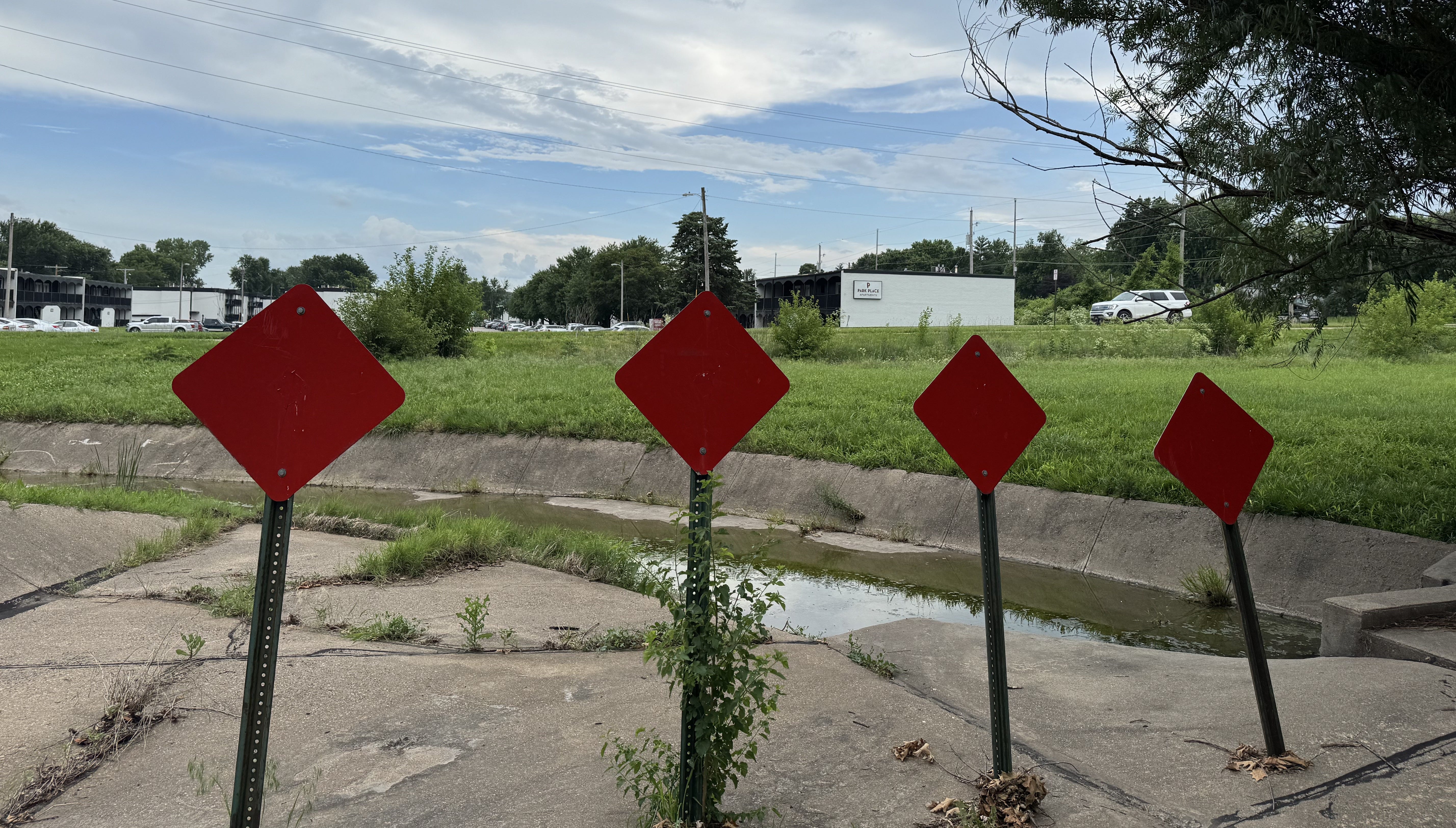
the ditch™ if you know you know
LONG LIVE THE DITCH, the birthplace of my childhood™️